
The "Zipper Effect" Terminator: Why Your High-Temp Insulation is Failing & The Truth Behind Woqin's 25% Energy Savings
Why do industrial pipelines operating between 300℃ and 800℃ remain dangerously hot and energy-inefficient, even when wrapped in thick layers of traditional mineral wool? This article exposes the "Invisible Zipper Effect" inherent in conventional insulation. Backed by certified CNAS data, Hebei Woqin (Woqin Aerogel) introduces two targeted engineering solutions based on a 650℃ threshold. By utilizing our "Multi-Layer Staggered Sealing System" and the "Hybrid Shielding System," we eliminate Corrosion Under Insulation (CUI) and deliver a verified 25% reduction in overall energy loss.
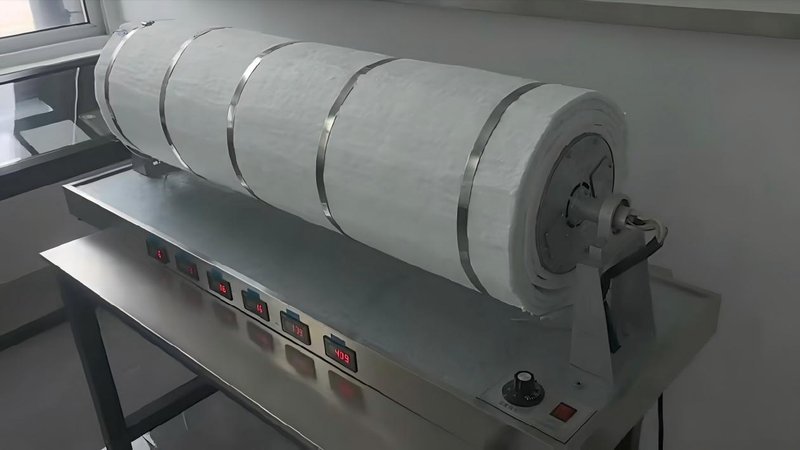
1. Industry Reality: Why is Your Insulation "Leaking" Heat?
In petrochemical plants, power generation, and metallurgical facilities, pipelines face extreme thermal challenges ranging from 300℃ to 800℃. Many facilities wrap these pipes in up to 150mm of traditional mineral wool, yet the surface temperature remains scalding. Why?
The primary culprit is the "Invisible Zipper Effect."
Under continuous industrial vibration and pipeline thermal expansion, the butt-joints of rigid or traditional fibrous materials separate, creating physical gaps of 1 to 3 centimeters. Heat escapes through these gaps just like an open zipper. No matter how thick the insulation is, without "structural sealing," energy will continually bleed out.
To address this, we must look at the physical limits of modern materials. In this article, we use 650℃ as our critical engineering threshold, as this is the long-term stable operating limit for high-performance silica aerogel.
2. The Material Breakthrough: Hard Data on Woqin Aerogel
To permanently solve structural heat leaks, the core material must possess extreme high-temperature stability. According to the latest national CNAS (China National Accreditation Service) test reports (Report No. available for download on our website), Hebei Woqin's Nano-Aerogel Blankets deliver disruptive performance:
- Over 2.5x the Thermal Resistance: At a scorching 300℃, Woqin Aerogel maintains a rigorously tested thermal conductivity of 0.039 W/(m·K). At this exact same temperature, traditional aluminum silicate degrades to 0.100 W/(m·K) or higher. Our heat-blocking capability is more than 2.5 times greater than traditional materials.
- Eradicating CUI: With a tested hydrophobicity rate of 99.7%, the material never absorbs water, completely cutting off the electrolyte environment required for Corrosion Under Insulation (CUI).
3. Mid-to-High Temp Applications (≤650℃): The Multi-Layer Staggered System
For pipelines operating below the 650℃ threshold, we have abandoned the traditional "single thick wrap." Instead, we calculate and deploy a "Multi-Layer Staggered Sealing System" (typically 4 to 8 layers of 10mm aerogel, depending on pipe diameter and target ambient temperature).
- Staggered Installation: The flexible nature of aerogel allows for staggered longitudinal and transverse joints, creating a "thermal maze." Even if the pipe shifts due to intense thermal expansion, surface temperatures remain firmly locked.
- The "Seam Killer" (Managing the Thermal Gradient): We incorporate a layer of single-sided aluminum foil fiberglass cloth.
- 👉 An Engineering Reality Check: Can aluminum foil withstand 650℃? No, standard foil cannot. That is exactly why Woqin's engineers NEVER place the foil directly against the hot pipe. The foil is strategically interleaved between the middle and outer aerogel layers. By the time the heat penetrates the first few aerogel layers, the temperature has dropped safely below 200℃. In this safe zone, the aluminum foil acts as an impenetrable radiant barrier and physically seals any potential micro-gaps from the inner layers.
4. Extreme Temp Applications (>650℃): The Objective Balance of "Hybrid Shielding"
When media temperatures exceed 650℃, any single material faces physical limits. Let's be objective: Aluminum silicate withstands extreme heat (1000℃+) but has poor thermal resistance; Aerogel has ultimate heat-locking ability, but degrades under direct, long-term contact with ultra-high temperatures (>650℃).
Therefore, Woqin engineered the Hybrid Shielding System, balancing the strengths of both materials:
- Inner Heat Resistance (The Sacrificial Layer): Aluminum silicate needle-punched blankets are applied directly against the ultra-hot pipe. This layer absorbs the initial thermal spike, rapidly dropping the outer contact temperature to a "safe zone" below 600℃.
- Outer Heat Locking: We seamlessly wrap multiple layers of Woqin Aerogel (interleaved with aluminum foil cloth) over the silicate, firmly locking in the remaining heat.
This hybrid approach leverages silicate for temperature resistance and aerogel for thermal insulation, saving over 50% of spatial volume compared to an all-silicate design.
5. Conclusion: From "Procurement Cost" to "ROI"
By adopting Hebei Woqin's Composite Sealing Systems, facilities do not just solve tight spatial constraints; they eradicate the "zipper effect" and boost overall thermal efficiency by approximately 25%.
Because of the drastic reduction in boiler fuel consumption and the zero-maintenance lifespan of the hydrophobic aerogel, our clients typically recover their entire material investment within 12 to 18 months.
👉 [Contact Woqin's Engineering Team Today for Your Custom 3D Thermal Calculation]

Written by - Ruibin An
Industry Veteran with 13+ Years of Experience. Deeply rooted in the insulation industry for over 13 years, specializing in supply chain optimization and global market trends for Rock Wool and Aerogel materials.
LATEST NEWS
The "Zipper Effect" Terminator: Why Your High-Temp Insulation is Failing & The Truth Behind Woqin's 25% Energy Savings
2026-03-04
Stop Paying to Ship Air: How Vacuum-Packed Glass Wool Cuts Freight Costs by 80%
2026-03-03
From "Bulky Quilts" to "Industrial Armor": Why Aerogel is the Core of Modern Removable Jackets
2026-03-02
The PFP-CUI Correlation: Why 2026 Asset Integrity Requires a Hybrid Insulation Strategy
2026-03-01
Hebei Woqin's Wired Mineral Wool Mats Officially Achieve GOST-R & Class NG Certifications
2026-02-27