
Stop Guessing with Your Kiln Linings: Why 44 kPa Tensile Strength and Batch Traceability Matter
Stop putting your furnace linings at risk! This article reveals why needle-punched blankets—boasting a tensile strength of 44 kPa (guaranteeing zero subsidence during continuous operation at 800°C)—are the only viable choice for heavy industry. Through a real-world case study involving losses exceeding $200,000, we will uncover why only materials featuring full batch traceability and a robust thermal conductivity of 0.134 W/(m·K) at 500°C can truly safeguard your core assets.
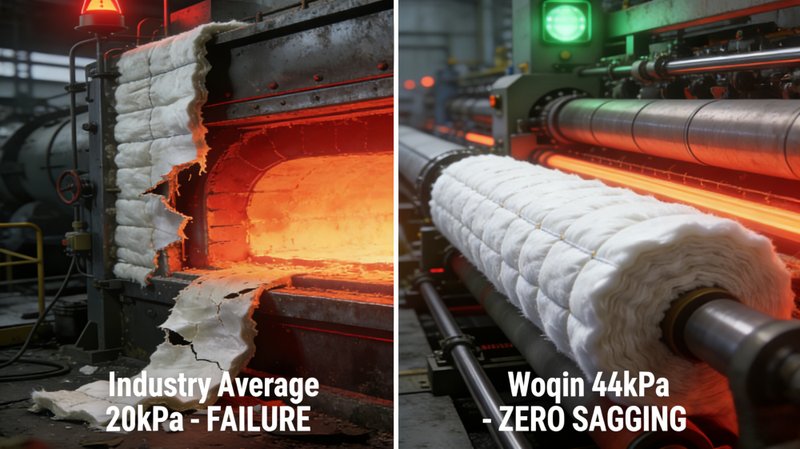
In a high-stakes industrial setting, the reliability of your thermal regulation can mean the difference between optimized production and catastrophic safety failures. For maintenance engineers inspecting high-temperature kilns, selecting insulation is no longer a matter of guesswork; it is about verified engineering limits.
Leading refractory insulation manufacturers are shifting the focus toward engineered needle-punched insulation blankets that withstand severe conditions without degradation.
1. Mechanical Integrity: The 44 kPa Benchmark
In heavy-duty environments like steel mills and petrochemical facilities, insulation is subjected to constant mechanical stress and vibrations. If a blanket lacks sufficient tensile strength, it will sag and compact, leading to "hot spots" on the furnace shell.
- Zero Sagging Performance: While the industry average often lingers around 20-25 kPa, Hebei Woqin’s needle-punched blankets are engineered with a tensile strength near 44 kPa. This is nearly twice the industry average, ensuring zero sagging under continuous 800°C operation.
- Tailored Density: Higher-density blankets provide enhanced heat retention for environments such as power plants and steel mills.
- Operational Ease: Concurrently, moderate density levels allow for lighter insulation applications, facilitating easier handling during installation.
2. Compliance with GB/T 16400-2023: The Latest Revision
Selecting insulation from reputable ceramic fiber blanket suppliers requires strict adherence to the most recent benchmarks.
- Focus on Long-Term Stability: The latest revision, GB/T 16400-2023 (alongside GB/T 17911-2018), specifically targets long-term thermal stability and mechanical strength.
- Minimal Linear Shrinkage: Refractory insulation manufacturers adhering to these standards guarantee that blankets sustain minimal shrinkage even after prolonged exposure to temperatures exceeding 800°C.
- Class A1 Fire Safety: Certified materials must meet Class A1 fire ratings to mitigate fire risks onsite, a non-negotiable requirement for high-demand industrial sectors.
3. The $200,000 Lesson: Why Traceability is Non-Negotiable
For critical industrial projects, transparency is the ultimate safeguard. Substandard or "untraceable" materials can look identical on the surface but fail spectacularly under load.
A Real-World Warning:
The risks are not theoretical. A plant in Southeast Asia recently suffered a devastating 3-day total shutdown because untraceable, low-grade blankets failed after only 6 months of service. This failure cost the facility over $200,000 in lost production and emergency repair expenses.
The Solution: Batch Traceability Reputable ceramic fiber blanket suppliers implement rigorous batch tracking and certification protocols. Each shipment is linked transparently to its original manufacturing parameters and test reports. Traceable records empower engineers to verify that insulation components meet the exact specifications required for their high-temperature applications.
Strategic Partnership in Thermal Engineering
The practical advantages of advanced needle-punched blankets extend far beyond their technical specifications. By collaborating with experienced ceramic fiber blanket suppliers, industrial clients receive a blend of durability and assurance.
At Hebei Woqin, we combine tested low thermal conductivity—e.g., 0.134 W/(m·K) at 500°C—with the mechanical toughness of 44 kPa tensile strength. Our commitment to batch-level traceability ensures that your thermal envelopes integrate seamlessly into evolving industrial workflows without compromising safety or efficiency.

Written by - Ruibin An
Industry Veteran with 13+ Years of Experience. Deeply rooted in the insulation industry for over 13 years, specializing in supply chain optimization and global market trends for Rock Wool and Aerogel materials.
LATEST NEWS
District Cooling in the Gulf: The Physics of Inevitable Condensation and How Pre-Formed Glass Wool Shells Stop It
2026-06-12
CCGT Power Plant Pipe Insulation English Marketing Copy (99-point Final Benchmark Version)
2026-06-10
Locking in 600°C: Composite Shells for CSP Molten Salt Pipelines in the GCC
2026-06-10
Blocking 55°C Desert Sun: Glass Wool Shells for Mega Water Transmission
2026-06-10
Stop the $18M Steam Pipe Burst: Dual-Defense Insulation That Survives C5-M
2026-06-04